Boss Friend: A Bold Display Font for Digital Impact
As a UI designer who ships dozens of landing pages, SaaS dashboards, and e-commerce experiences each year, I don’t reach for display fonts lightly. They’re not background players — they’re tone-setters, hierarchy anchors, and brand accelerants. Boss Friend is one of those rare display fonts that delivers immediate visual authority without sacrificing digital legibility or design control.
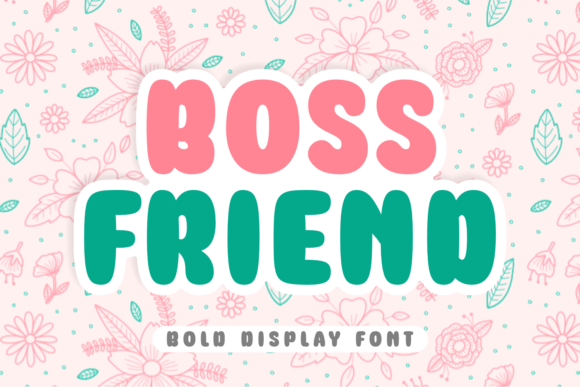
Boss Friend is a chubby, high-contrast display typeface — friendly but unapologetically bold. Its rounded terminals, generous x-height, and subtle squishiness give it warmth and approachability, while its sturdy proportions ensure it holds up at scale on any screen. It’s not a script font, nor a minimalist sans serif — it occupies that sweet spot between playful and professional, making it ideal for brands that want to stand out without seeming unserious.
In practice, Boss Friend excels where attention must be directed: hero section headlines, product name tags, course title banners, and CTA buttons with personality. On a coaching website, it transforms “Start Your Journey” from generic to memorable. In an online boutique, it gives product collections like “Summer Edit” or “Handmade Only” instant character. And on a portfolio site, it makes project titles feel like exhibition labels — curated, intentional, and visually grounded.
Readability isn’t compromised — it’s redefined. Boss Friend wasn’t built for body copy, and it shouldn’t be used that way. But for short-form, high-impact text (under 8 words), it performs exceptionally well across devices. On mobile, I use it at 32–40px for hero titles with tight letter-spacing (–2% to –4%) and generous line-height (1.1–1.2) to preserve rhythm. Against dark backgrounds, I add a subtle text-shadow (1px 1px 2px rgba(0,0,0,0.15)) for contrast; over light image overlays, I apply a soft semi-transparent background behind the text block to keep it legible without obscuring the visual.
Visual hierarchy is where Boss Friend truly shines. Because it commands space so effectively, it naturally demotes supporting elements — which is exactly what you want in conversion-focused layouts. Pair it with a clean, neutral sans serif like Inter, Manrope, or Poppins for body copy and interface labels. That contrast creates breathing room, guides scanning behavior, and reinforces brand clarity. For editorial or luxury-leaning sites, try pairing Boss Friend with a refined serif like Crimson Pro or Lora — the juxtaposition adds sophistication while keeping the voice human and grounded.
It’s also highly effective in logo design and branded web components. When used as logo text — especially for creative studios, indie makers, or wellness brands — Boss Friend conveys confidence without coldness. Its consistent stroke weight and open counters help it render cleanly at small sizes (down to 24px) in favicon previews, app store badges, and social profile headers. Just avoid stretching or distorting it — let its natural proportions do the work.
For online stores, Boss Friend works best on hero banners, limited-edition collection headers, and “new arrival” ribbons — never on price tags or size selectors. In course sales pages, it elevates benefit-driven headlines like “Build Your First Portfolio” or “Ship in 7 Days” — turning functional statements into brand moments. And in digital ad creatives (especially static banners and email headers), its chunky forms survive compression and small viewports better than many decorative alternatives.
Before implementation, always check the font package: Boss Friend typically includes multiple weights (Regular, Bold, sometimes Black), OpenType features like stylistic alternates and ligatures, and robust webfont support (WOFF2, WOFF). Confirm multilingual coverage if your audience spans European or extended Latin scripts — most modern releases include accented characters and basic diacritics, but verify before launching global campaigns.
Licensing matters — especially for client work and commercial products. Boss Friend is a premium font, and its license covers web use, desktop design, and embedded digital assets like PDFs and presentations. However, redistribution — such as including it in a template sold on ThemeForest or bundling it with a Figma UI kit — requires an extended license. Always review the foundry’s terms before shipping templates, white-labeled dashboards, or SaaS-branded themes.
Where Boss Friend falls short is in long paragraphs, data-dense tables, or micro-interactions like form field hints. It’s not a utility font — it’s a statement font. Use it where you want users to pause, recognize, and remember. That means avoiding it in navigation menus (stick with your system or sans serif there), footer links, or error messages. Reserve it for moments where your brand has something meaningful to say — and wants to say it with presence.
In responsive layouts, I often serve Boss Friend only above 768px for headings, then swap to a system font or lighter display variant on mobile — unless the headline is critical to conversion, in which case I optimize spacing and contrast instead of swapping. This keeps load times lean while preserving impact where it counts.
Finally, consider how Boss Friend supports your broader brand identity. Does it reflect your voice? If your brand is warm, confident, and human-centered — yes. If it’s ultra-minimalist, technical, or corporate-formal, test carefully. A font like Boss Friend doesn’t just sit on the page — it participates in the conversation your site is having with users. Choose it when you want that conversation to begin with energy, clarity, and unmistakable character.
- Best for: Hero titles, logos, CTA banners, shop collection headers, course names, blog post titles
- Avoid for: Body copy, form labels, navigation, footers, dense data tables
- Ideal pairings: Inter, Manrope, Poppins (sans serif); Crimson Pro, Lora (serif)
- Web considerations: Optimize letter-spacing, test contrast on all backgrounds, verify WOFF2 support
- Licensing note: Web embedding is standard — extended license required for resale or template distribution